If you run an air compressor for a nailer, an impact wrench, a blow gun or a spray gun, the hose between them is the part you handle all day. It gets dragged across floors, coiled and uncoiled, left in a cold van and pulled round corners. This guide covers how to choose and use the Notas PU hose for pneumatic tools: what the polyurethane construction gives you, how it copes with cold mornings, how to check that the bore suits your tool, and what this hose is and is not meant for.
What Notas PU hose is built from
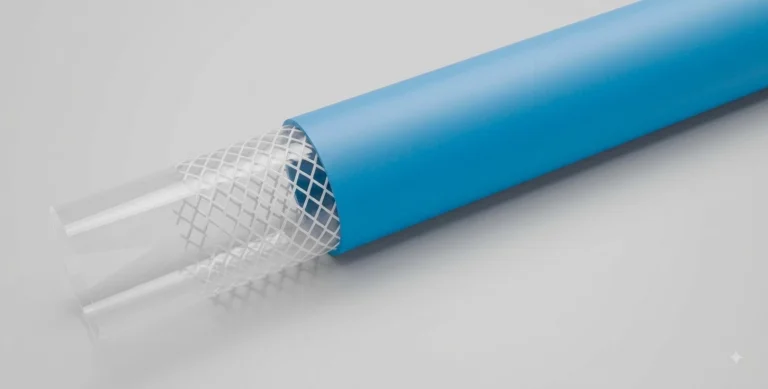
The product page describes Notas PU as an extremely light and flexible PU hose for pneumatic tools and paint guns. Each layer has a job:
- Tube: abrasion and solvent resistant polyurethane. This is the layer the air runs through.
- Reinforcement: synthetic cord.
- Cover: UV, abrasion and weather resistant blue polyurethane. This is the outside surface that rubs against concrete, bench edges and vehicle floors.
- Temperature range: -15°C to +80°C.
The hose is stocked in an 8 mm inner diameter and priced per metre, offered as a 1 m length or a 50 m coil.
Why polyurethane suits an air line
Notas PU uses polyurethane for both the tube and the cover, and the page describes the hose as extremely light and flexible.
Weight and handling. A light, flexible hose follows you round a job rather than dragging the tool sideways. That matters most with a spray gun, where you want the gun to move freely, and with tools you hold overhead.
Wear. The cover is abrasion resistant polyurethane, which helps where the hose is dragged across floors. It is also UV and weather resistant, which helps if the hose lives outdoors or in a van rather than on a reel indoors.
The inner tube. The tube is abrasion and solvent resistant polyurethane. That is a description of the tube material, not a licence to pump solvents through the hose. Its stated application is pneumatic tools and paint guns.
Flexibility in the cold
Some air hose goes stiff on a cold morning and kinks as you uncoil it. The Notas PU page states that the hose remains flexible even at low temperatures, with a working range down to -15°C.
If the hose is kept somewhere unheated, check that it stays within the stated range of -15°C to +80°C: -15°C is the bottom of the range, and +80°C is the top. Do not leave the hose against a hot exhaust, a compressor head or anything else that could take it above +80°C.
Choosing the bore and length for your tool
Notas PU is stocked in one bore, 8 mm. Before you order, check that 8 mm suits what you are connecting:
- Measure the inside, not the outside. The bore is the inner diameter. If you are replacing an old hose, cut a clean end and measure across the hole. Our guide on how to measure hose bore shows the method.
- Check your fittings. The hose tail or push-on connector on your coupler needs to match the 8 mm bore. A tail that is too small will leak; one that is too large is hard to fit and stresses the hose.
- Check the tool's air requirement. Tools that use a lot of air, and long runs from the compressor, can need a larger bore than light-duty tools. Your tool and compressor manuals are the place to check what they recommend. If they call for something other than 8 mm, ask us before you buy.
Secure each joint with a clamp sized to the outside diameter of the hose, not the bore, and make sure the clamp sits fully over the hose tail.
For length, measure the route from the compressor to the furthest point you will work, allow for the hose going round obstacles, and add a little slack so it never pulls tight on a fitting. Excess hose lies on the floor, gets trodden on and kinked. Our page on buying hose cut to length explains how ordering by the metre works. Cut-to-length hose is prepared to your specification and cannot be returned unless it is faulty, so measure twice.
What it is for, and what it is not for
The product page lists one application, compressed air for:
- Pneumatic (air) tools
- Paint guns
The page does not describe the hose as suitable for fuel, drinking water, food, chemicals, steam or hot water, and it gives no pressure rating. Do not use it for any of those, and do not assume a pressure figure from another hose. If you want to use it for anything other than an air line to a tool, or you need to confirm it suits your compressor's output, call or message us first.
Looking after the hose
- Route it without sharp bends and away from sharp edges, and do not drive over it.
- Uncoil it fully before use so it does not kink under pressure.
- Inspect it regularly for cuts, cracks or a damaged cover, especially near the fittings, and cut back or replace any section that is damaged.
- Release the pressure before disconnecting a tool or changing a fitting.
- Store it coiled loosely, out of the way of heat sources.
How to order or ask
Choose the 1 m or 50 m option on the Notas PU hose page. It is priced per metre ex VAT. If you are not sure the 8 mm bore suits your tool, or you want to check an application, tell us the tool or gun, the fittings you are using and the length of run, and we will help. You can use the "Ask about this" link or order on WhatsApp from the product page, or call +44 (0) 7717 217388. Stocked lines ordered before 14:00 on a working day are packed the same day; cut lengths are prepared to order and can take an extra working day. Delivery details are on our delivery page.