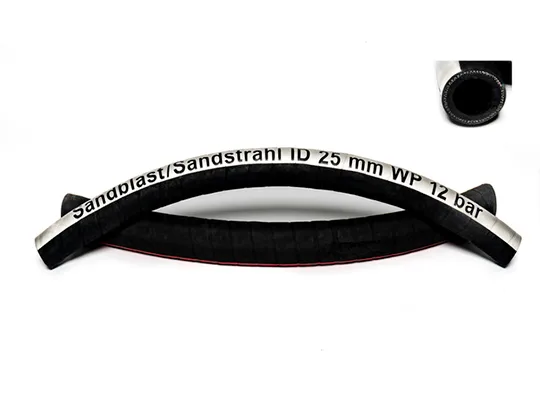
A blast hose wears from both sides: abrasive runs along the inside of the tube while the outside is dragged over concrete, steel and grit. Choosing the right one comes down to a few questions: how well the tube resists wear, which bore suits your blast pot and nozzle, how you will connect it, and how you will know when it has had enough. This guide works through each one using our sandblast hose, ~56 mm³ as the example.
What the hose is for
The hose is made for conveying abrasive sandblasting materials in cleaning and blasting metal, casting and concrete surfaces. That covers the usual jobs: stripping paint and rust from steelwork, cleaning castings, and preparing concrete before a coating goes on.
Its construction is built around wear:
- Tube: synthetic rubber, black, abrasion resistant. This is the layer the abrasive runs against.
- Reinforcement: synthetic cord, which gives the hose its body.
- Cover: synthetic rubber, black, abrasion and weather resistant, with a cloth impression finish.
- Temperature: -30°C to +80°C.
When the hose is not in use, coil it loosely and keep it off sharp edges.
What the ~56 mm³ abrasion figure means
The listing gives a resistance to abrasion of ~56 mm³, to DIN 53516. The figure is a volume of material, in cubic millimetres, so if you are comparing hoses, compare only figures quoted to the same standard.
Real hose life depends on the abrasive you use, how much air and media you push through it, and how the hose is routed. Even a hard-wearing tube will wear quickly if it is run around a tight corner where the abrasive hits the same spot of tube all day.
25 mm or 32 mm bore
The hose is offered in two inner diameters, 25 mm and 32 mm. The bore is the inside diameter, and it is the size that has to match your fittings. If you are not sure what you have, our guide on how to measure hose bore explains how to check it.
As a general rule for any blast line:
- 25 mm is lighter and easier for one operator to handle and drag around a job. It suits smaller pots and smaller nozzles.
- 32 mm carries a larger volume of air and abrasive with less resistance along the line, which helps on longer runs and with larger nozzles. It is heavier to move.
The deciding factor is usually not preference but what your equipment is built for. The outlet on the blast pot, the couplings and the nozzle holder are all made for a particular hose size. Start from those, not from the hose.
Sizing it to the blast pot and nozzle fittings
Before ordering, check three things on your existing set-up:
- The pot outlet coupling. Look at the tail or insert that goes into the hose. Its size tells you the bore it was made for.
- The nozzle holder. The holder at the operator's end also has a tail sized to the hose bore. It must match the same bore as the pot end.
- Any joints along the line. If you are joining two lengths, both couplings need to suit the same bore.
Blast couplings and nozzle holders usually grip the outside of the hose as well as the inside, so they are made for a particular hose wall. Fit a coupling to a test piece before you cut the whole run, and make sure the hose sits fully home on the tail. Where a clamp is used, size it to the hose outside diameter and tighten it evenly. A coupling that comes off under load lets the hose whip, so this is worth getting right.
The listing does not state an electrical conductivity or antistatic rating. If your blasting set-up or site rules require one, ask us before you order.
Routing the hose on the job
Most blast hose wears out in a few places rather than along its whole length, and those places are set by how it is laid out.
- Lay the line in long, gentle curves. Tight bends make the abrasive strike the same part of the tube and wear it through.
- Avoid kinks, and do not let the hose fold over itself at the pot outlet or nozzle end.
- Keep it off sharp edges, steel corners and freshly blasted surfaces where it can be cut or scuffed.
- Do not drive or drop heavy loads on it, and do not drag it by the coupling.
- Use the shortest length that reaches the work comfortably. Extra hose adds weight and resistance without any benefit.
Inspecting it and knowing when to replace it
Check the hose before each shift, with the system depressurised. Look and feel for:
- Soft spots, bulges or thin areas, especially near bends and near each coupling.
- Cracks, cuts or gouges in the cover deep enough to expose the cord reinforcement.
- Abrasive or air leaking at a coupling, or a coupling that has moved on the hose.
- Wear at the nozzle end, where the hose is handled and flexed the most.
Replace the hose, or cut out the damaged section and re-couple it, as soon as you find a soft spot, exposed reinforcement or a leak. A worn blast hose can fail suddenly and the abrasive will come out at speed, so it is not worth running it to the end. If the same section always wears first, change the route rather than just the hose.
How to order
The sandblast hose, ~56 mm³ is priced per metre ex VAT. The listing offers it by the metre (1 m option) or as a 40 m length, in 25 mm or 32 mm bore. To order, choose the bore, matched to your pot outlet and nozzle holder, and the length option that suits your run. Stocked lines ordered before 14:00 on a working day are packed the same day, and cut lengths are prepared to order; see delivery for costs and timings. Cut-to-length hose cannot be returned unless it is faulty, so check your couplings first. If you are unsure which bore fits, or what you are blasting with, call +44 (0) 7717 217388 and we will help you pick.