Bore is the hole, not the hose
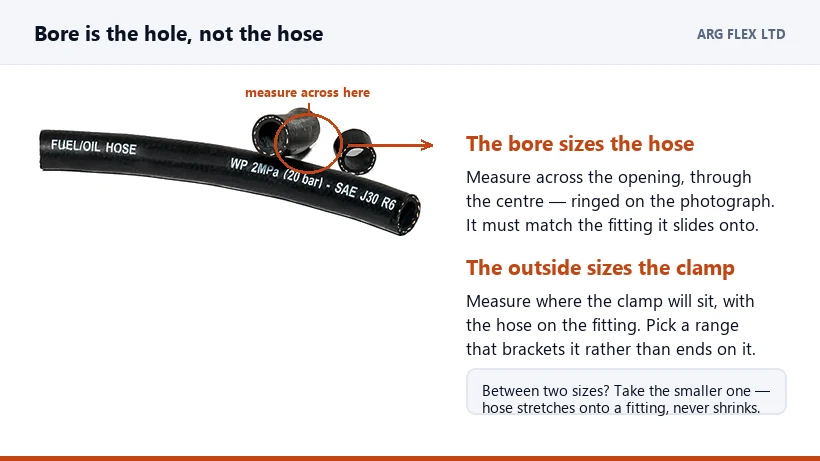
Hose is specified by its inner diameter — the bore — because that is what has to slide over your fitting and that is what decides how much gets through it. The outside diameter varies with wall thickness and reinforcement, so two hoses with the same bore can be noticeably different on the outside.
Nearly every “it does not fit” starts here: an outside measurement ordered as if it were a bore.
Measuring the bore
- Measure across the opening at the end of the hose, through the centre, not across a chord.
- Use vernier calipers on the inside jaws if you have them. A ruler held across a round hole reads small.
- Measure a clean, uncut, unstretched end. An end that has been forced onto a fitting is permanently belled out and will read large.
- If the hose is already on a fitting, measure the fitting’s outside diameter instead. That is the number the bore has to match.
Measuring for the clamp
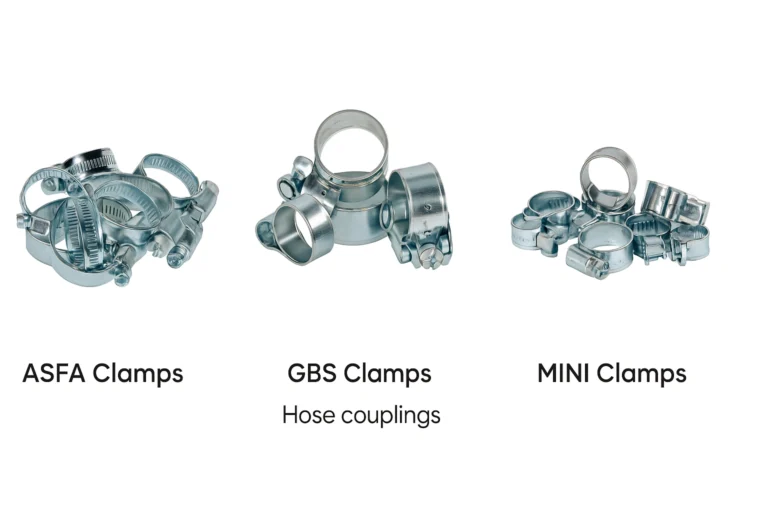
Clamps are sized by the outside diameter of the hose, with the fitting inside it. Measure the hose where the clamp will sit, with the hose on the fitting if you can, and pick a clamp whose range brackets that figure rather than ending exactly on it. A clamp at the very end of its travel has nothing left to tighten.
Worm-drive clamps here cover from 8 mm up to 265 mm across four ranges, with W1 zinc-plated steel as standard and W2, W4 and W5 stainless available to order.
Bores we hold
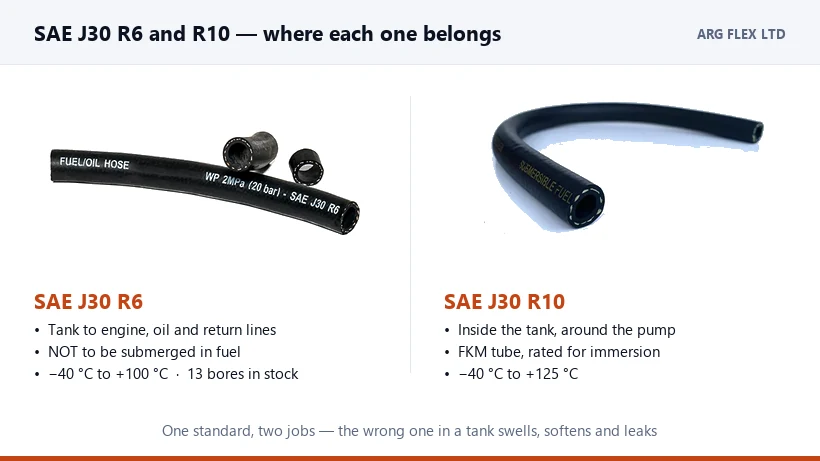
Fuel, oil and general-purpose hose runs in close steps through the small sizes, because that is where engine work lives: 3 mm, 3.2 mm, 4 mm, 5 mm, 6 mm, 6.3 mm, 7 mm, 8 mm, 10 mm, 11 mm, 12 mm, 12.5 mm, 12.7 mm, 14 mm, 15 mm, 16 mm, 18 mm, 19 mm, 22 mm and 25 mm. Ducting and transfer hose carries on at 32 mm, 127 mm, 152 mm and 180 mm.
Some of those are imperial sizes written in millimetres and it is worth knowing which: 6.3 mm is a quarter inch, 12.7 mm is a half inch, 25 mm is near enough an inch. If your fitting came off an older or an imported machine, the odd-looking number is usually the right one.
When the bore falls between two sizes
Go to the smaller one. Hose stretches onto a fitting and grips; it does not shrink onto one. A bore slightly under the fitting makes a tight joint that a clamp can finish. A bore over it will leak however hard the clamp is done up, and over-tightening to chase that leak cuts into the hose.
If the gap is more than a millimetre or so, that is a sign the fitting is a different standard rather than a near miss — send us the measurement and what it came off.