If you have searched for "clear reinforced PVC hose", you probably want a line you can see through, that bends easily, and that is reinforced rather than plain clear tube. FILCLAIR PVC hose for liquids and air is the clear, textile-reinforced hose we stock for that job. This guide covers what the product page says it carries, what it must not be used for, the bores available, and how to decide whether you need it rather than an unreinforced clear tube.
What FILCLAIR is made of
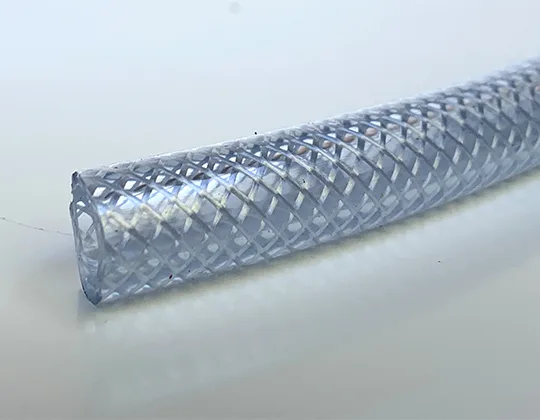
FILCLAIR has a tube and cover of flexible clear PVC with a textile cord reinforcement. The textile cord is the difference between this hose and a simple clear tube. The PVC is clear, so you can watch the flow, spot air pockets, and see dirt or sediment building up before it causes a blockage.
The stated temperature range is -15°C to +60°C, so keep it away from hot water lines and heat sources.
What it is meant to carry
The product page lists FILCLAIR as assigned to the flow of:
- Liquids
- Compressed air
- Industrial gases
- Light chemical products
The page also states that the hose keeps its shape in vacuum up to Ø 25 mm. All the bores we stock are below that size, but the page gives no vacuum level, so if you plan to use it on a suction line, ask us about your specific duty before ordering.
The page refers to working pressure and burst pressure being measured at +23°C, but does not publish the figures. If your application depends on a specific pressure, ask us before ordering rather than assuming a rating.
What it must not carry
The page is clear on one point: FILCLAIR is not suitable for hydrocarbons and derivates. That means no petrol, diesel, heating oil, lubricating oil, hydraulic fluid or fuel vapour. The page gives this as a firm limit, so do not test it. For fuel and oil, choose a hose whose page states it is made for those products.
On food and drinking water, read the wording exactly. The page says that FILCLAIR AL is suitable for delivery of water and food products, with the exception of alcohol solutions higher than 15%, and that FILCLAIR N is not suitable for food. If your line will carry anything you will eat or drink, contact us before ordering and confirm which version you are getting. Do not assume food suitability from the clear appearance alone.
Bores available
FILCLAIR is stocked in three inner diameters:
- 8 mm, the smallest bore stocked
- 10 mm
- 12 mm, the largest bore stocked
The choice of bore depends on the spigot or barb size. The size quoted is the bore, the inside diameter, and it should match the outside diameter of the spigot or barb you are pushing it onto. If you are unsure, our guide on how to measure hose bore walks through it. Too large a bore leaks even with a clamp; too small and you will struggle to get it on and may split the wall.
FILCLAIR is priced per metre. Pick the bore on the product page and add the number of metres you need. If you want one continuous length for a longer run, mention it when you order so we can confirm it.
Reinforced or unreinforced clear tube: how to choose
Plain clear PVC tube and FILCLAIR look similar on a shelf, but they behave differently once in use. Ask yourself these questions:
- Is there any pressure in the line? Compressed air puts the wall under load. The page gives no pressure rating, so ask us before using FILCLAIR on a pressurised line. Unreinforced tube is better suited to gravity feeds and very low pressure.
- Is there suction? On the inlet of a pump or a siphon, unreinforced tube can collapse. The page states FILCLAIR keeps its shape in vacuum up to Ø 25 mm; ask us about your specific suction duty.
- Will the hose be bent round corners? Whatever hose you use, route it in gentle curves and avoid sharp bends that can pinch it shut.
- Is the line carrying gas or air? FILCLAIR is listed for compressed air and industrial gases. If you need that, use a hose that states it.
If the answer to all of these is no, a simple clear tube may be enough. If any answer is yes, a reinforced hose is worth considering; check the pressure with us first.
Fitting and looking after it
Use a hose clamp at every joint, sized to the outside diameter of the hose rather than the bore, and tighten it onto the spigot, not past the end. Route the hose away from sharp edges and moving parts, keep it within the -15°C to +60°C range, and check it from time to time. The clear wall makes inspection easy: cloudiness, cracking near the fittings, or cord that is exposed or frayed at the surface are signs it is time to replace that section.
How to order or ask a question
Before you order, have three things ready: the bore you need (8, 10 or 12 mm), the length in metres, and what will go through it. Then order on the FILCLAIR product page, or use the Ask about this button there if you need to check food suitability or pressure for your job. Stocked lines ordered before 14:00 on a working day are packed the same day, and cut lengths are prepared to order; see delivery for UK rates. Cut-to-length hose cannot be returned unless faulty, so it is worth asking first if you are unsure. You can also call us on +44 (0) 7717 217388.